 Skip to content


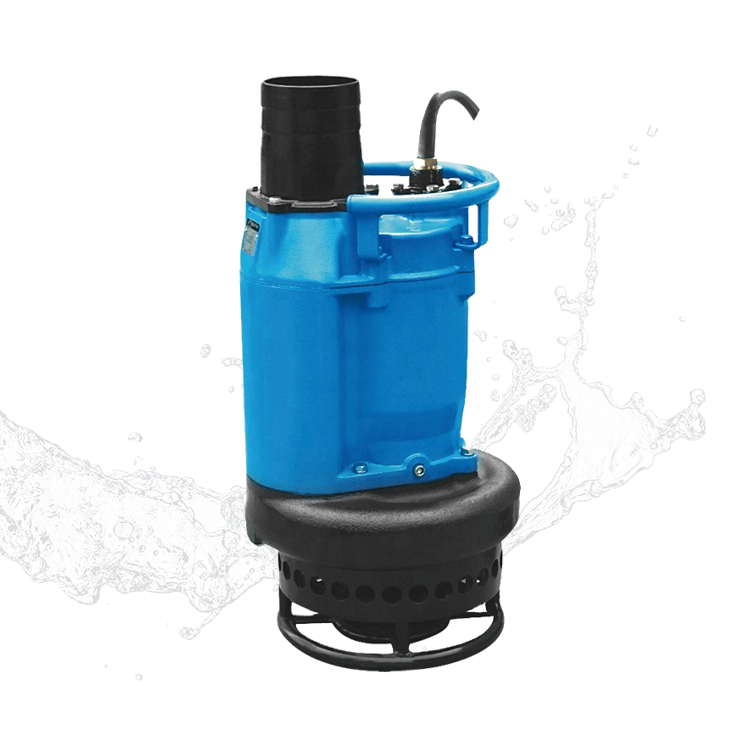

TUSSU®KBS Series is a heavy-duty, submersible slurry pump designed specifically to handle highly abrasive, dense, and challenging mediums. Combining robust metallurgy, integrated agitation, and an efficient motor cooling configuration, the KBS series stands as an industry benchmark for sand, sludge, and slurry management in municipal, industrial, and mining operations


More Product Details
The body of motor and pump is made of rigid cast iron forlong-lasting durability.
Greatly increased maximum submersion depth due to mechanical seal resistant to high pressure.
Both semi-open impeller and wear plate are made of high chrome alloy.
The hardness of this material is at least 58 HR, it’s more durable than other materials(ductile iron).
Effective motor cooling due to discharge channel cast as part of the motor housing. Space economy by a top outlet
Discharge 50mm (2″) to 150mm (6″). Motor l.5kW (2HP) to 15kW(20HP).
Hermetically sealed motor equipped build-in thermal protection for the power below 15kW.
KBS Submersible Slurry Pump Performance Curve


KBS Submersible Slurry Pump Technical Data
| Model 50/60HZ | Outlet | Motor power | Starting Method | Rated current (380V) | Rated capacity | Rated head | Max capacity | Max head | impeller passage | |||
|---|---|---|---|---|---|---|---|---|---|---|---|---|
| kW | HP | m³/h | m³/min | m³/h | m³/min | |||||||
| KBS44 | 80 | 4 | 5.5 | D.O.L. | 10.2 | 60 | 1.00 | 10 | 99 | 1.65 | 14.8 | 30 |
| KBS46 | 100 | 6 | 8 | D.O.L. | 13.8 | 90 | 1.50 | 10 | 144 | 2.40 | 16.9 | 30 |
| KBS49 | 150 | 9 | 12 | D.O.L. | 19.5 | 100 | 1.67 | 15 | 192 | 3.20 | 21.5 | 30 |
| KBS415 | 200 | 15 | 20 | D.O.L. | 30.1 | 200 | 3.33 | 16 | 372 | 6.20 | 22 | 30 |
| KBS422 | 200 | 22 | 30 | Star-Delta | 42.0 | 200 | 3.33 | 24 | 360 | 6.00 | 32 | 30 |
KBS Submersible Slurry Pump Structure:

| Item No. | Part name | Material | Item No. | Part name | Material | |
|---|---|---|---|---|---|---|
| 01 | Hose coupling | Cast iron | 25 | Strainer | Steel | |
| 02 | Handle | Steel | 27 | Stator | ||
| 05 | Upper cover | Cast iron | 28 | Rotor | Shaft:AISI420SS | |
| 07 | Bearing house | Cast iron | 31a | Bearing | Ball bearing | |
| 11 | Motor body | Cast iron | 31b | Bearing | Ball bearing | |
| 13 | Pump body | Cast iron | 34 | Mechanical seal | Sic-Sic/Sic-Sic Tc-Sic/Sic-Sic( > 15kW) | |
| 14a | Impeller | High chrome alloy | 35 | Oil seal | ||
| 14b | Agitator | High chrome alloy | 47 | Cable | ||
| 16a | Inlet plate | High chrome alloy | ||||
| 16b | Inlet plate | Cast iron |
FAQ:
Q1: What makes the KBS series different from standard submersible sewage or dewatering pumps?
A: Standard dewatering or sewage pumps are only designed to move water and suspended light solids. If you put them in thick sludge, the solids settle around the pump, block the suction, and overheat the motor.
The KBS Series is a dedicated slurry pump. It features two critical differences:
- Integrated High-Chrome Agitator: Located below the suction inlet, it mechanically beats and mixes settled solids, sand, and mud back into suspension, turning it into a pumpable fluid.
- Heavy-Duty Metallurgy: The impeller, agitator, and inlet plate are cast from High-Chrome Alloy to resist severe erosion. A standard sewage pump would wear out within days in these conditions.
Q2: What is the exact maximum solid size the KBS pump can handle? Will it clog easily?
A: Every model in the KBS range (from the 3-inch KBS44 to the 8-inch KBS422) features a uniform 30 mm (1.18 inches) impeller passage.
Because of the wide internal clearance and the pre-mixing action of the agitator, it handles large particles, pebbles, and gravel smoothly. However, to protect the pump from oversized rocks or massive debris, the pump is equipped with a heavy-duty steel strainer at the base.
Q3: How does the KBS pump manage motor cooling if it is only partially submerged?
A: This is one of the biggest operational advantages of the KBS design. It utilizes a top-discharge, slim-line layout.
When the pump runs, the pumped slurry is forced up through a jacket that completely surrounds the motor housing before exiting the top discharge outlet. This continuous flow of slurry acts as a natural water-cooling jacket. As a result, the KBS can run safely and continuously even when it is only partially submerged or working in low-water drawdown applications without risk of burning the motor.
Q4: Submersible pumps are notorious for seal failures. What is the sealing mechanism on the KBS?
A: Seal failure is the #1 cause of motor burnout in slurry applications, which is why the KBS uses a dual-protection layout:
- Dual Silicon Carbide (SiC-SiC) Mechanical Seals: Housed safely in an isolated oil chamber. SiC-to-SiC faces provide maximum hardness and zero fluid ingress, even under abrasive pressure.
- Heavy-Duty Upgrades (>15 kW): For the larger KBS415 (15 kW) and KBS422 (22 kW) models, the seals are upgraded to Tungsten Carbide-to-Silicon Carbide (Tc-SiC) on the high-pressure side to handle the massive back-pressure generated at higher heads (up to 32 meters).
Q5: Can I run the KBS pump directly from my standard power line, or do I need a specialized control panel?
A: It depends on the specific model’s power rating:
- KBS44 to KBS415 (4 kW up to 15 kW): These models use D.O.L. (Direct On Line) starting. While they can technically connect directly via a standard breaker, we strongly recommend a basic control panel with over-current and phase-failure protection to safeguard your investment.
- KBS422 (22 kW / 30 HP): This heavy-duty model requires a Star-Delta starting method. A Star-Delta starter panel is mandatory here to reduce the high inrush current during startup and protect your local power grid.
Q6: The impeller and suction plate will eventually wear down. Are these parts adjustable, or do I have to replace them immediately?
A: You do not need to replace them immediately. The KBS series is designed for industrial longevity. As abrasive slurry slowly wears down the high-chrome impeller and inlet plate over months or years of service, the gap between them will widen, causing a slight drop in pumping efficiency.
To fix this, the pump features an adjustable suction clearance mechanism. You can easily adjust the inlet plate closer to the impeller during routine maintenance to restore original hydraulic performance, significantly extending the wear life of the parts before a replacement is required.
Q7: What are the typical wear-part replacement intervals, and are your spare parts interchangeable?
A: Wear-part life depends entirely on the slurry’s concentration, particle sharpness, and operating hours. In standard sand mining or bentonite dredging, high-chrome components typically last between 3,000 to 5,000 operational hours.
Q8: What are the absolute limits of the slurry medium (Temperature, pH, Density)?
A: To ensure safe operation, the slurry medium should fall within the following parameters:
- Medium Temperature: Maximum 40℃ (104℉) for standard models. (High-temperature customizations can be requested).
- pH Range: 6.5 to 8.5 (Standard cast iron/high-chrome construction handles neutral to slightly alkaline mining/construction water).
-
Slurry Density: Maximum SG (Specific Gravity) of 1.2. If your slurry is thicker than this, the motor will pull excessive current, requiring a review of your flow rate or system head.


